

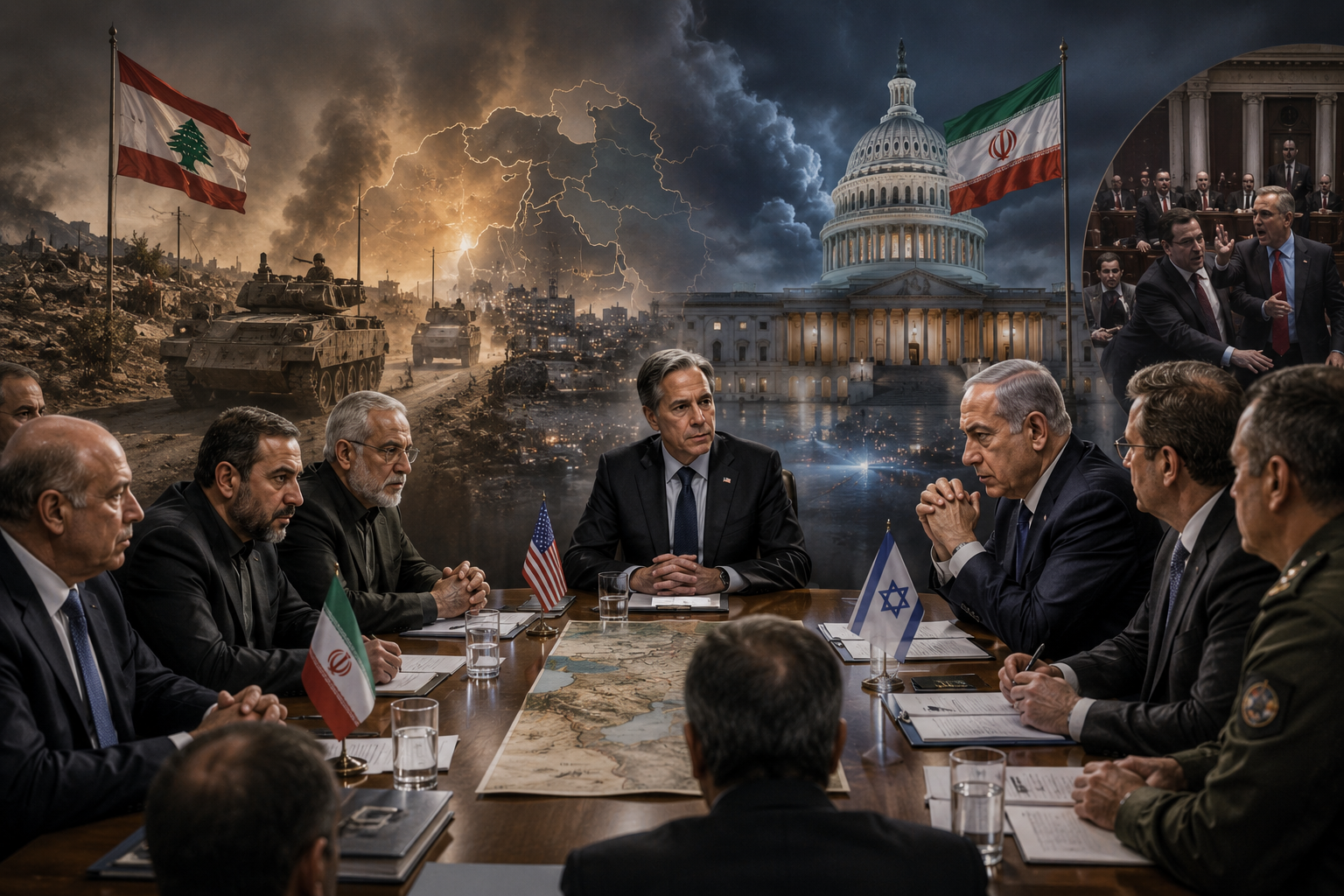
The Iran war ceasefire looked like a breakthrough just days ago. After months of regional fighting, direct US-Iran diplomacy, and fears of a wider Middle East war, Washington and Tehran reached an interim framework meant to stop the conflict and create a path toward a broader agreement. But by June 24, that fragile calm was already under strain.
The Iran war ceasefire now sits in the middle of several overlapping crises. In Washington, President Donald Trump clashed with Republican senators over war powers and the Iran deal. In Lebanon, Israeli operations and ceasefire violations threatened to reopen a front that had only just quieted down. At the same time, talks over inspections, troop deployments, and control of southern Lebanon showed that the region is nowhere near settled.
That is what makes this story so important. The Iran war ceasefire is not a clean peace deal with clear winners and a stable end point. It is a tense pause layered with political fights, military distrust, and unresolved demands from almost every side involved. One day after another, the ceasefire is being tested by Congress, by Israel, by Hezbollah, and by the basic question of whether the US and Iran actually agree on what happens next.
Here are the 7 biggest twists shaping the Iran war ceasefire right now and why this moment could decide whether the region moves toward diplomacy or slips back into war.
The Iran War Ceasefire Is Holding — But Only Barely
The first thing to understand is that the Iran war ceasefire is still alive, but it is far from secure. The broader interim arrangement between the United States and Iran was meant to stop active hostilities and open a 60-day window for further negotiations on sanctions, nuclear inspections, and regional security issues. Yet even as the diplomatic framework remains in place, violence around Lebanon has shown just how fragile the calm really is.
A major reason the Iran war ceasefire feels unstable is that it does not operate in a vacuum. The ceasefire is tied to multiple regional flashpoints, especially southern Lebanon, where Israel and Hezbollah had been exchanging fire. A reported halt in fighting between Israel and Hezbollah created room for diplomacy, but incidents on the ground have continued to test that truce.
That means the Iran war ceasefire is not just about Washington and Tehran. It also depends on whether Lebanon remains quiet, whether Israel accepts restraint, and whether proxy fronts stay under control long enough for diplomacy to work.
Why the ceasefire still feels so shaky
Several factors are keeping the Iran war ceasefire under pressure:
- The agreement is interim, not final
- It leaves major issues unresolved, including nuclear inspections
- Fighting in Lebanon has not fully stopped
- Trump faces heavy domestic criticism over the terms of the deal
- Israel has not fully aligned itself with the broader diplomatic direction
That combination is why the Iran war ceasefire looks less like a finished peace and more like a very fragile pause.
Trump’s Fight With Senate Republicans Exposed How Politically Weak the Deal Still Is
One of the biggest shocks around the Iran war ceasefire on June 24 came in Washington, where Trump clashed with Senate Republicans over the war and the diplomacy surrounding it. According to Reuters, Trump had a heated confrontation with Sen. Bill Cassidy in a closed-door meeting after Cassidy criticized the administration’s handling of the conflict, the lack of transparency, and the fact that the war had not fully met its stated objectives.
That clash matters because the Iran war ceasefire is not only a foreign policy issue anymore. It has become a domestic political battle inside Trump’s own party. Some Republicans believe the agreement with Iran gave too much away. Others are angry that Congress has not had enough oversight over a war that cost billions and changed the balance of power across the region.
Later that same night, Senate Republicans blocked a resolution aimed at ending US hostilities with Iran by a 50-47 vote, even after previous war-powers efforts had drawn bipartisan concern. That sequence captured the political contradiction at the heart of the Iran war ceasefire: Trump wants credit for ending the war, but many lawmakers still do not trust the way he fought it or the deal he signed to stop it.
Why Trump’s Senate fight matters for the ceasefire
The Iran war ceasefire depends partly on whether Trump can keep political control at home. Right now, that is clearly not guaranteed.
The Senate tension matters because it shows:
- Republicans are split over the cost and terms of the deal
- Trump is facing criticism from senators who believe the White House hid key details
- Congress could become a bigger obstacle if negotiations drag on
- The ceasefire may not have strong political backing even inside the president’s own party
So while the Iran war ceasefire is framed as a diplomatic milestone, it is also becoming a political liability for Trump.
Israel and Lebanon Are Testing the Limits of the Iran War Ceasefire
If the Washington drama is one threat to the Iran war ceasefire, the battlefield tension in Lebanon is another. On June 23, Israeli gunfire in southern Lebanon killed two people, according to Lebanese authorities, marking the first fatalities since a ceasefire linked to the broader Iran diplomacy had begun. Hezbollah accused Israel of violating the truce, while Israel said it had targeted militants operating near a bulldozer under civilian cover.
That incident matters because the Iran war ceasefire was supposed to create space for de-escalation not only between Washington and Tehran, but also across the wider network of Iran-linked conflict zones. Lebanon is the most immediate test of whether that can happen. If southern Lebanon remains unstable, the broader ceasefire framework becomes much harder to defend.
AP also reported that Israel and Hezbollah had agreed to halt fighting in southern Lebanon amid fears that continued clashes would derail the US-Iran diplomatic track. But even that ceasefire came with warnings. Israeli shelling continued after the reported arrangement, and Prime Minister Benjamin Netanyahu maintained that Israel would keep military pressure in the area until threats were eliminated.
Why Lebanon matters so much to the Iran war ceasefire
The Iran war ceasefire can survive harsh political criticism. What it may not survive is a major military collapse in Lebanon.
Lebanon matters because:
- It is the clearest proxy front tied to the US-Iran conflict
- Hezbollah is closely linked to Iran
- Israel’s actions in southern Lebanon can quickly escalate into a larger regional fight
- Continued clashes make it harder for Iran to defend diplomacy at home
In other words, the Iran war ceasefire will be judged not only by what happens in negotiation rooms, but by whether the guns in Lebanon actually stay quiet.
Israel Is Still Refusing a Full Withdrawal From Southern Lebanon
Another major twist in the Iran war ceasefire story is that Israel is still standing firm on southern Lebanon. Reuters reported on June 24 that Israel and Lebanon are discussing a US-backed pilot scheme under which some parts of southern Lebanese territory currently occupied by Israeli forces would be transferred back to the Lebanese army. The idea is to create limited “pilot zones” where US-trained Lebanese troops take control while Israel retains a buffer near the border.
That may sound like progress, but it also reveals a deeper problem: Israel is not offering a full withdrawal. Lebanese officials have made clear that a complete Israeli exit remains a core goal. Hezbollah has also condemned Lebanon’s participation in the talks, which shows how politically explosive the arrangement is inside Lebanon itself.
This matters for the Iran war ceasefire because any long-term peace framework will eventually run into the territorial question. If Israel insists on staying in parts of southern Lebanon while Iran-linked groups insist on full withdrawal, then the current ceasefire may simply be postponing the next confrontation.
What the pilot plan tells us
The proposal shows that diplomacy is happening, but it also shows how limited that diplomacy still is.
The southern Lebanon talks reveal that:
- Israel is willing to discuss partial handovers, not a total retreat
- Lebanon wants full restoration of sovereignty
- The US is trying to manage the area through incremental security arrangements
- Hezbollah remains deeply hostile to any process it sees as legitimizing Israeli presence
That is why the Iran war ceasefire still feels like a holding pattern rather than a clean peace.
The Nuclear Inspection Dispute Shows the US and Iran Are Still Negotiating in Public
Even beyond Lebanon, the Iran war ceasefire is being tested by the fact that Washington and Tehran still do not agree on core terms of the deal. One of the biggest disputes right now is over nuclear inspections.
AP reported that the head of the International Atomic Energy Agency, Rafael Grossi, said inspections of Iran’s enrichment sites are required under the signed agreement. Iranian officials pushed back, saying those inspections would happen only after a final agreement and the lifting of sanctions.
That disagreement matters because the Iran war ceasefire is not just about stopping bombs. It is also supposed to create a pathway to a broader arrangement around Iran’s nuclear program. If the two sides cannot even agree on when inspectors should enter key sites, then the road to a lasting deal looks much rougher than the initial ceasefire headlines suggested.
Why the inspection fight is so important
The inspection dispute matters because it gets to the core of whether the Iran war ceasefire is a real framework or just a political truce.
Key unresolved questions include:
- When can the IAEA inspect enrichment sites?
- What sanctions relief comes first, and under what conditions?
- How much enriched uranium will Iran downblend or move?
- What happens if either side accuses the other of cheating?
Those are not side issues. They are central to whether the Iran war ceasefire can evolve into a durable agreement.
Netanyahu May Be One of the Biggest Political Losers of the Ceasefire
Another striking development is the way the Iran war ceasefire is reshaping Israeli politics. Reuters reported that the US-Iran interim deal may leave Benjamin Netanyahu as one of its biggest casualties. For years, Netanyahu built his political identity around the idea that he alone could shape Washington’s Iran strategy and hold a hard line against Tehran. Now, Trump is pursuing a settlement that appears to ignore some of Israel’s objections and leaves Netanyahu politically exposed.
This matters because the Iran war ceasefire is not just pausing violence. It is redistributing political leverage. Netanyahu’s long-standing goals — weakening Iran decisively, neutralizing Hezbollah, and emerging from the conflict with a stronger regional hand — all look much harder to achieve under a US-led diplomatic track that prioritizes de-escalation.
If Netanyahu feels sidelined, that could make Israel even more likely to test the edges of the ceasefire in Lebanon or elsewhere. That does not mean Israel will blow up the deal outright, but it does mean the Iran war ceasefire now exists in a regional political environment where one of the most important actors may feel deeply unsatisfied with the outcome.
The Ceasefire Has Bought Time, Not Peace
At this point, the most honest way to describe the Iran war ceasefire is this: it has bought time, but it has not created peace. The guns are quieter than they were at the height of the war, and diplomacy has replaced some of the battlefield momentum. But almost every major issue that fueled the conflict remains unresolved.
Trump still faces a domestic political backlash. Congress still wants more oversight. Israel still wants room to act in Lebanon. Hezbollah still rejects Israeli occupation. Iran still disputes how and when nuclear inspections should happen. And all of this is unfolding inside a 60-day negotiation window that could easily end in a breakthrough — or in another collapse.
That is why the Iran war ceasefire feels so unusual. It is not the end of a war in the traditional sense. It is a crowded, contested attempt to freeze a conflict before it spreads again.
What could happen next
The next phase of the Iran war ceasefire likely depends on several immediate developments:
- Whether US-Iran technical talks can narrow the inspection dispute
- Whether Israel and Lebanon make progress on southern border arrangements
- Whether Hezbollah and Israeli forces avoid another major escalation
- Whether Trump can hold Republican support as critics keep attacking the deal
- Whether the interim ceasefire survives long enough to become a broader settlement
None of those outcomes is guaranteed. That is why this story is still moving so fast.
Final Thoughts
The Iran war ceasefire is one of those moments that looks simple from a headline and much messier once you step inside it. Yes, there is a diplomatic framework in place. Yes, fighting has eased compared with the worst days of the war. But no, the region is not stable, and no, the agreement is not secure.
By June 24, the ceasefire was already being squeezed from multiple sides. Trump was battling Senate critics at home. Israel was still refusing a full withdrawal from southern Lebanon. Lebanon’s ceasefire front had already seen deadly violations. And the US and Iran were publicly disputing key terms of their own deal, especially over nuclear inspections.
That is the real story of the Iran war ceasefire right now. It is not a clean ending. It is a high-stakes pause in which every player is still trying to shape the next chapter. If diplomacy holds, this could become the start of a larger settlement. If it breaks, the region may find itself right back on the edge of a much wider war.
Read Other Interesting news here: Vaping Causes Cancer
