

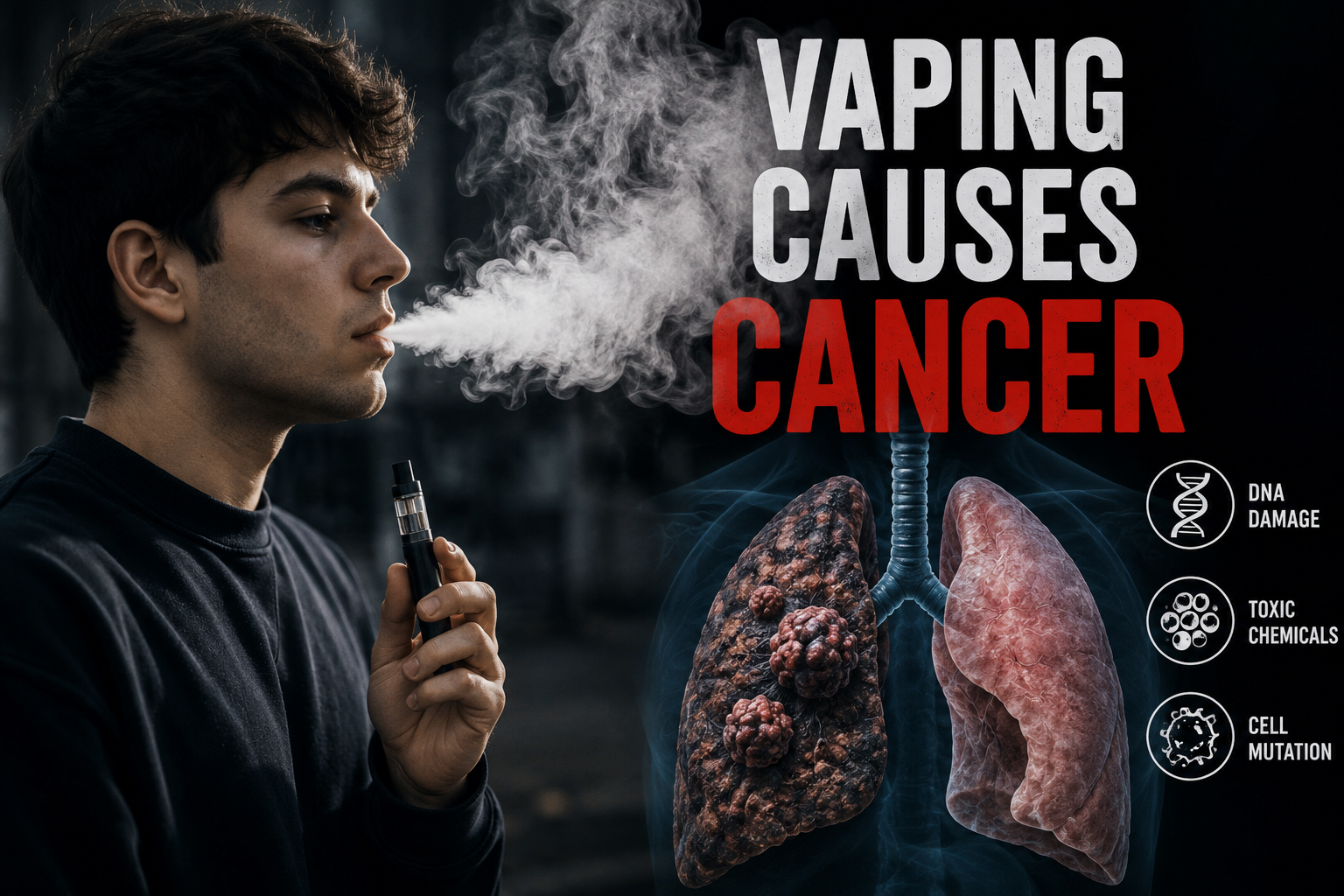
The debate around e-cigarettes has changed fast, and this time the warning is much harder to ignore. A major scientific review has concluded that vaping causes cancer risks are now serious enough to demand attention from regulators, doctors, parents, and anyone still treating e-cigarettes as a harmless habit. For years, vaping was marketed as the cleaner, safer, modern alternative to smoking. It looked smoother, smelled lighter, and came wrapped in the language of harm reduction.
Now, a sweeping review led by researchers at UNSW Sydney says the evidence points in a very different direction. The researchers concluded that nicotine-based e-cigarettes are likely to cause lung cancer and oral cancer. In other words, the concern is no longer just whether vaping is “less bad than cigarettes.” The bigger question is whether vaping causes cancer on its own, even when smoking is taken out of the picture. Based on the evidence reviewed, the answer is moving closer to yes.
That conclusion did not come from one small lab test or one dramatic case report. The review pulled together evidence from human biomarker studies, animal research, and laboratory studies examining the chemicals created by e-cigarettes. The paper was published in the journal Carcinogenesis and involved experts from The University of Queensland, Flinders University, The University of Sydney, Royal North Shore Hospital, The Prince Charles Hospital, and Sunshine Coast University Hospital.
The reason this matters so much is simple: if vaping causes cancer, then the public conversation around e-cigarettes is overdue for a major correction. Here are the biggest takeaways from the review and why the phrase “vaping causes cancer” is now at the center of a much more serious health warning.
A Major Review Now Says Vaping Causes Cancer Risk in the Lungs and Mouth
The heart of the story is the review’s main conclusion. After assessing a broad body of evidence, the researchers said nicotine-based e-cigarettes are likely to cause cancers of the lungs and oral cavity. That is one of the strongest statements yet from mainstream researchers on whether vaping causes cancer directly, rather than only through its relationship with cigarette smoking.
Lead researcher Adjunct Professor Bernard Stewart said the review was the most definitive determination so far that people who vape are at increased cancer risk compared with those who do not vape. The researchers focused specifically on whether e-cigarettes may be carcinogenic in their own right, which is a key shift from older research that often looked mainly at vaping as a gateway to smoking.
That is a major reason the review stands out. It does not argue that vaping is risky only because it might lead someone to tobacco. It argues that vaping causes cancer risk through the aerosol, chemicals, and biological damage produced by the devices themselves.
Why this conclusion is different from older vaping studies
Many earlier vaping studies asked whether vaping was safer than smoking. This review asked a tougher question: does vaping itself appear to cause cancer? That shift matters because a product can be less harmful than cigarettes and still be dangerous in its own right.
The review’s conclusion was based on a wide evidence base, not one isolated result. That is why the phrase vaping causes cancer now carries much more weight than it did even a year ago.
The Review Focused on Lung Cancer and Oral Cancer for a Reason
When researchers say vaping causes cancer risk, they are not speaking in vague terms. The review specifically pointed to lung cancer and oral cancer as the two clearest concerns. That makes sense because those are the tissues that are most directly exposed when someone inhales e-cigarette aerosol.
The mouth, throat, airways, and lungs are the first places where heated vape chemicals make contact. According to the review, these tissues show biological changes linked to cancer development, including DNA damage, oxidative stress, and inflammation. Researchers said there is no doubt that the cells and tissues of the oral cavity and the lungs are altered by inhalation from e-cigarettes.
That is why the conclusion that vaping causes cancer risk is centered so strongly on these two areas. The mouth and lungs are not just random organs chosen for attention. They are the tissues taking the direct hit every time a person vapes.
Why the mouth and lungs are the main concern
The review points toward these areas because:
- The oral cavity is directly exposed to aerosol with every puff
- The lungs repeatedly absorb heated chemicals and particles
- Studies found DNA damage and inflammation in tissues linked to these areas
- These are also the same organs where smoking-related cancers are commonly seen
So when the researchers say vaping causes cancer risk, they are following the path of exposure and the pattern of damage.
Human Studies, Animal Research, and Lab Data All Point in the Same Direction
One of the strongest parts of the review is that it did not rely on only one kind of evidence. The authors looked across clinical monitoring, animal experiments, and mechanistic laboratory studies. That matters because e-cigarettes have not been around long enough to produce the kind of lifetime human cancer data that tobacco eventually produced.
Because of that time gap, scientists have to look at earlier warning signs. The review found that people who vape show biomarkers linked to cancer risk. It also found animal evidence of tumors after exposure to e-cigarette aerosols, along with laboratory evidence that vape chemicals can damage cells in ways that are closely tied to carcinogenesis. That broad consistency is one reason the authors felt comfortable making such a strong statement that vaping causes cancer risk is likely real.
The three evidence streams behind the warning
The review used three major types of evidence:
- Human biomarker studies showing oxidative stress, inflammation, and chemical exposure
- Animal studies showing tumor development after exposure to e-cigarette aerosol
- Laboratory studies showing how vape chemicals can damage DNA and alter cells
That mix is important because it means the vaping causes cancer warning is not built on a single weak pillar. It is built on multiple streams of evidence pointing in the same direction.
Vape Aerosol Is Not Just “Harmless Vapor”
A huge part of the old vaping sales pitch was the idea that users were inhaling vapor rather than smoke, which made the product sound almost clean. But the review makes clear that this framing is misleading. E-cigarette aerosol contains a mix of substances that researchers believe may help explain why vaping causes cancer risk is becoming a serious concern.
The review pointed to volatile organic compounds, heavy metals, nicotine-related compounds, and other toxic chemicals generated during vaporization. These substances can damage DNA, trigger inflammation, and place stress on tissues that are already exposed to heat and repeated inhalation. The researchers argue that these chemicals are not incidental. They are central to why vaping causes cancer risk cannot be dismissed anymore.
That is also why the “it’s just flavored water vapor” argument does not hold up. The aerosol produced by e-cigarettes is chemically active and biologically disruptive. It may not look like cigarette smoke, but the review suggests that its long-term health impact could still be deeply harmful.
Harmful substances highlighted in the review
Researchers pointed to several concerning components in vape aerosol, including:
- Volatile organic compounds
- Heavy metals from heating elements
- Nicotine byproducts
- Chemical compounds linked to DNA damage
- Substances associated with oxidative stress and inflammation
All of that strengthens the argument that vaping causes cancer risk is not just theoretical.
DNA Damage and Inflammation Are the Early Red Flags
One of the biggest reasons the review concludes that vaping causes cancer is likely is the presence of precancerous biological changes. Cancer usually does not appear overnight. It tends to grow out of repeated damage, inflammation, stress on cells, and genetic disruption over time. That is exactly why the review paid so much attention to biomarkers.
The researchers found that vaping is associated with DNA damage, oxidative stress, epigenetic change, and inflammation — all of which are warning signs strongly linked to cancer development. These are the kinds of early biological changes that scientists look for when they are trying to understand whether a product may be carcinogenic before decades of population-level cancer data exist.
This is one of the most important parts of the whole story. The review is not saying “we have 40 years of human cancer outcomes already.” It is saying that the body is already showing the kinds of changes that strongly support the conclusion that vaping causes cancer risk should be taken seriously right now.
Why these biological changes matter
These markers matter because they are part of the pathway toward cancer:
- DNA damage can trigger abnormal cell growth
- Oxidative stress can injure tissues and accelerate cellular harm
- Inflammation creates an environment that can support tumor development
- Epigenetic changes can alter how genes behave over time
That is why the review treats them as powerful evidence that vaping causes cancer risk is more than a distant possibility.
The Review Warns Against Repeating the Cigarette Mistake
Another striking part of the review is the historical comparison. Researchers say public health should not repeat the mistake it made with smoking. It took roughly 100 years from the earliest tobacco warning signs to the point where smoking was formally recognized as a cause of lung cancer. By then, millions of people had already been exposed for decades.
The authors argue that if the world waits the same length of time for perfect long-term data on vaping, it may again be acting far too late. That does not mean every early warning automatically proves causation. But it does mean that when human, animal, and mechanistic evidence all line up, policymakers should not ignore the possibility that vaping causes cancer just because the devices are newer than cigarettes.
That message is really the review’s public health core. The authors are saying the warning signs are already strong enough to justify action, awareness, and a more cautious public message.
Why waiting decades could be dangerous
Researchers believe delay would be risky because:
- E-cigarettes have only been widely used for about 20 years
- Cancer often takes a long time to become visible in population studies
- The early biological warning signs are already present
- Youth vaping means a large group may now be exposed for years before the full risk is known
So when the review says vaping causes cancer is a likely conclusion, it is also making a time-sensitive argument: do not wait until the damage is impossible to deny.
Dual Use Could Make the Risk Even Worse
The review also highlighted a real-world problem that often gets overlooked: many people do not fully switch from smoking to vaping. Instead, they do both. That matters because if vaping causes cancer risk on its own, then combining vaping with cigarettes could be even more dangerous.
Some evidence discussed around the review suggests that dual users may face a much higher lung cancer risk than people who smoke alone or do neither. The broader concern is that vaping has often been framed as a clean off-ramp from smoking, but in practice many users get stuck in a long-term nicotine loop that includes both products.
That makes the phrase vaping causes cancer even more important. It is not just about non-smokers who pick up a vape. It is also about smokers who think they are reducing harm while potentially adding another source of toxic exposure.
Why dual use changes the conversation
Dual use matters because it can:
- Keep people addicted to nicotine longer
- Increase exposure to multiple carcinogenic chemicals
- Undercut the claim that vaping is automatically a safer exit strategy
- Make long-term health risk harder to judge and possibly worse
So even if someone started vaping to quit smoking, the review suggests that the assumption of safety needs to be challenged.
Young People and Non-Smokers May Be Underestimating the Risk
One of the clearest public health implications of the review is what it means for young users. Many teens and young adults who vape have never smoked traditional cigarettes. For them, the question is not whether vaping is better than tobacco. It is whether vaping causes cancer risk in people who may be using these products for years without understanding the long-term consequences.
That is why several experts reacted strongly to the review. If vaping is causing DNA damage, inflammation, and other precancerous changes in young users who otherwise might never have smoked, then the public health implications are huge. Bright flavors, sleek devices, and social acceptance may have helped normalize a habit that the evidence now suggests could carry much more danger than many people realize.
Why younger users are a major concern
Young people matter in this story because:
- They may vape for many years before symptoms appear
- Some began vaping without ever using cigarettes
- Early nicotine addiction can lead to long-term exposure
- The idea that vaping is “safe enough” may encourage regular use
If vaping causes cancer, then the youngest users may be the ones who pay for today’s misunderstanding years down the line.
The Review Still Has Limits — but the Warning Is Clear
It is important to be precise here. The review does not claim to know the exact number of future cancer cases caused by vaping. The authors themselves said their assessment is qualitative, not a precise numerical estimate of risk or disease burden. They also acknowledged that long-term population studies will still be needed to measure exactly how large the risk is.
But that limitation does not erase the conclusion. The review still says vaping causes cancer risk is likely, and it says that because the available evidence across different fields is remarkably consistent. So while scientists cannot yet say “vaping will cause X number of cancers per 100,000 users,” they are saying the warning signs are already too strong to ignore.
What the review claims — and what it does not
The review does claim:
- Vaping causes cancer risk is likely real
- Lung and oral cancer are the clearest concerns
- The evidence across human, animal, and lab studies is consistent
The review does not claim:
- An exact cancer rate for all vapers
- That vaping is identical to smoking in overall risk
- That every person who vapes will develop cancer
That balance matters, and it is the fairest way to explain the science.
Final Thoughts
The biggest shift in this story is not just scientific. It is cultural. For years, vaping lived in the space between caution and convenience — risky enough to raise eyebrows, but still widely treated as the cleaner alternative to smoking. This review challenges that comfort zone directly. Its message is that vaping causes cancer risk can no longer be dismissed as a distant theory or a fringe concern.
According to the review published in Carcinogenesis, nicotine-based e-cigarettes are likely to cause lung cancer and oral cancer, based on evidence from human biomarkers, animal studies, and laboratory research. The researchers found repeated signs of DNA damage, oxidative stress, inflammation, and toxic chemical exposure in the tissues most affected by vaping.
No, scientists still cannot tell us the exact long-term cancer burden of vaping. That part will take more time. But the evidence has moved far enough that the old myth of harmless vapor is getting harder to defend. If the public, policymakers, and younger users keep treating e-cigarettes as low-risk lifestyle devices, they may be ignoring one of the most important warning signs in tobacco and nicotine research right now.
Read Other Interesting news here: France Ebola Case
