

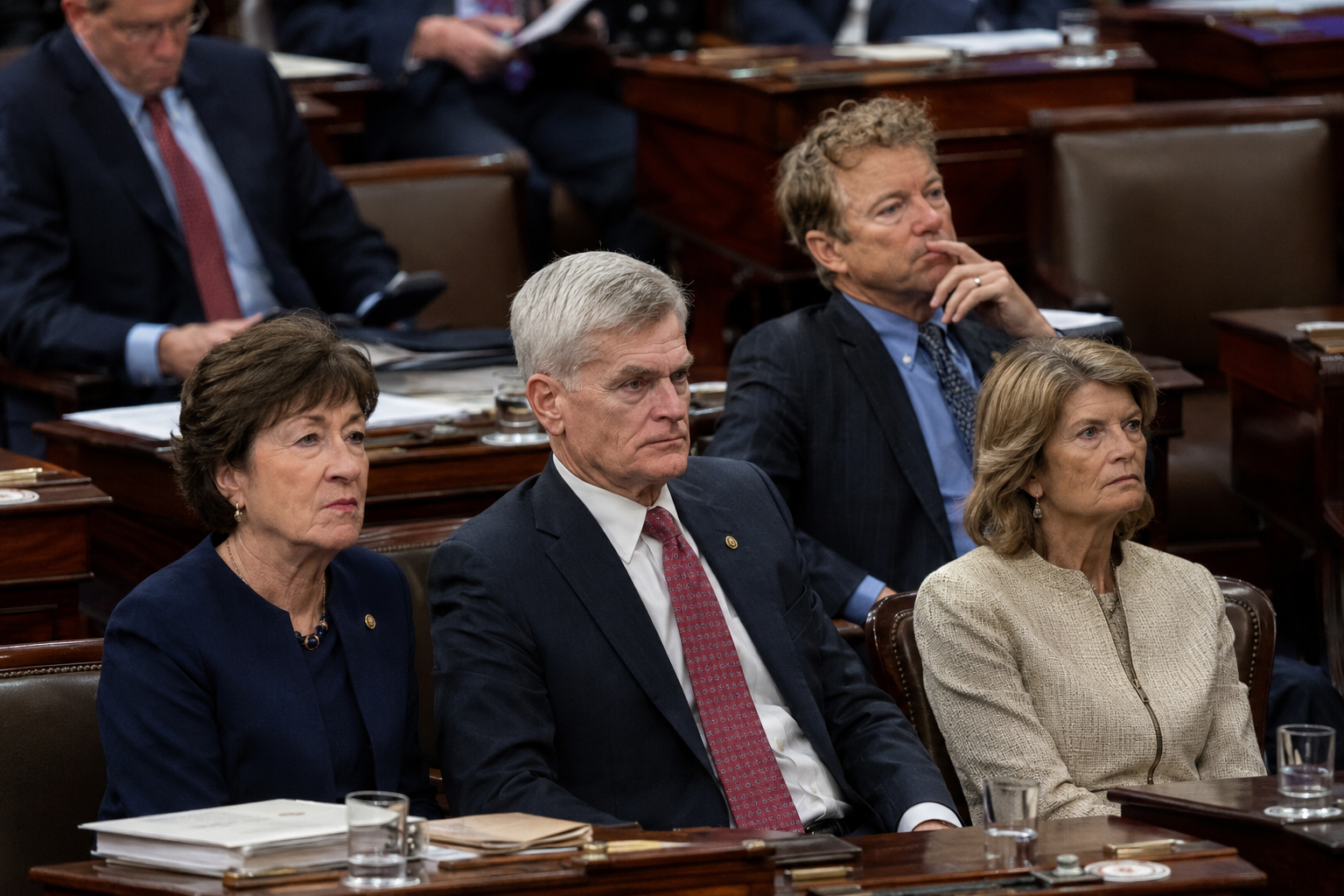
The GOP senators Iran vote has become one of the most dramatic political stories to come out of Washington this week. In a rare and highly charged split inside the Republican Party, four Republican senators voted with Democrats to block President Donald Trump from resuming military action against Iran without congressional approval. The vote did not just challenge the White House on foreign policy. It also exposed a deep crack between Trump and members of his own party at a tense moment in his second term.
The Senate approved the measure by a 50-48 vote, with Susan Collins, Bill Cassidy, Lisa Murkowski, and Rand Paul joining Democrats in support. Two Republicans — Mitch McConnell of Kentucky and Dave McCormick of Pennsylvania — missed the vote, while Democratic Senator John Fetterman of Pennsylvania voted against the resolution. Trump reacted furiously, accusing the four Republicans of making his job harder and publicly calling them “losers.”
What makes the GOP senators Iran vote so important is that it was not just about one military decision. It was about presidential power, congressional oversight, and whether Trump can keep total control over Republican lawmakers when the issue is war. Here is a full look at the vote, the four Republicans who broke ranks, and why their decision matters so much.
Why the GOP Senators Iran Vote Became Such a Big Political Story
The GOP senators Iran vote centered on a war powers resolution tied to the War Powers Resolution of 1973. That law was designed to give Congress oversight when a president sends U.S. forces into hostilities abroad. Under the law, presidents are supposed to remove forces from such conflicts within 60 days unless Congress authorizes the action.
The Senate measure aimed to block Trump from resuming the Iran war without that approval. The vote came after weeks of political tension over the administration’s military actions and its later ceasefire deal with Tehran. Trump and many Republicans argued that the war was effectively over and that the resolution was either unnecessary or unconstitutional. Democrats and a small group of Republicans disagreed, saying Congress still had a duty to set limits before any future strikes or renewed hostilities.
That is why the GOP senators Iran vote landed so hard politically. It was not a quiet procedural move. It was a direct challenge to Trump’s handling of war powers, and it forced Republican senators to decide whether they would stand with the president or with Congress’s constitutional role in war decisions.
The final Senate vote at a glance
Here is how the vote broke down:
- 50 senators voted in favor of the resolution
- 48 senators voted against
- 4 Republicans joined Democrats
- 1 Democrat, John Fetterman, voted no
- 2 Republicans missed the vote: Mitch McConnell and Dave McCormick
Those numbers turned the GOP senators Iran vote into one of the clearest signs yet that not every Republican is willing to follow Trump on national security without question.
The Four Republican Senators Who Broke with Trump
At the center of the GOP senators Iran vote were the four Republicans who crossed party lines: Susan Collins, Bill Cassidy, Lisa Murkowski, and Rand Paul. Each came to the vote for different reasons, but all four ended up making the same core argument in one form or another: if the United States is going to stay involved in military conflict with Iran, Congress should have a say.
That common thread is what made the GOP senators Iran vote so powerful. These were not random defections. Each senator had a specific political, constitutional, or strategic reason for backing the resolution.
Susan Collins Framed the Issue as a Constitutional Limit on Trump
For Sen. Susan Collins of Maine, the GOP senators Iran vote was rooted in Congress’s constitutional authority over war. Collins began siding with Democrats once it became clear that Trump could push past the war powers law’s 60-day deadline without explicit congressional approval.
Back in April, Collins had already warned that any further military action against Iran needed a clear mission and a defined strategy. Her position was not simply anti-war. It was more specific than that. She argued that the president’s role as commander in chief still has legal limits and that the Constitution gives Congress an essential role in decisions involving war and peace.
That made Collins one of the clearest institutional voices in the GOP senators Iran vote. Her message was simple: a deadline written into law is not optional, and Congress should not be sidelined if the United States is moving toward more fighting.
Why Collins’s vote mattered
Collins’s decision stood out because she is often seen as one of the more cautious Republicans in the Senate. When someone like Collins breaks with Trump on a war issue, it signals more than personal disagreement. It suggests concern about executive overreach and about what happens if Congress stops defending its own powers.
Her vote also helped frame the GOP senators Iran vote as a constitutional story, not just a partisan one.
Bill Cassidy’s Vote Reflected Both Frustration and Political Distance from Trump
Bill Cassidy of Louisiana may have cast one of the most politically loaded votes in the GOP senators Iran vote. Cassidy has clashed with Trump before and was one of the seven Republicans who voted to convict him during the 2021 impeachment trial. More recently, Cassidy failed to make a runoff in May after voters in his state followed Trump’s push to remove him.
Cassidy has said he supports efforts to dismantle Iran’s nuclear program, so his vote was not based on sympathy for Tehran or opposition to confronting Iran. Instead, he argued that Congress had been kept “in the dark” and that his constituents were concerned about deeper U.S. involvement in the war. He also sharply criticized the administration’s ceasefire arrangement with Iran, calling it a major foreign policy mistake and warning that Iran’s leverage over the Strait of Hormuz remained intact.
That background gave Cassidy’s role in the GOP senators Iran vote extra weight. He was not just voting against Trump in the abstract. He was signaling frustration with both the administration’s strategy and the lack of transparency around it.
Why Cassidy’s switch drew so much attention
Cassidy’s vote mattered because he has become one of the clearest examples of a Republican senator willing to absorb political damage rather than simply follow Trump. By the time of the GOP senators Iran vote, he had already paid a price in his own state for previous breaks with the president.
That history made his vote look less like a one-off protest and more like a continuation of a long-running conflict with Trump’s style of leadership.
Lisa Murkowski Changed Her Position as the 60-Day Deadline Passed
Lisa Murkowski of Alaska did not begin on the same side as Democrats. She initially voted against earlier resolutions to block strikes on Iran. But as the legal deadline passed and tensions in the region continued, she flipped and joined the effort to limit further military action without congressional approval.
Murkowski argued that the White House could not claim the war was over while U.S. forces were still operating in the region and the possibility of renewed hostilities remained real. If the administration expected troops to remain involved or wanted the option to strike again, she said, then it should come before Congress and make that case openly to lawmakers and to the public.
She also pointed to the economic side of the conflict. In Alaska, high energy prices were already hurting communities, and Murkowski noted that the closure of the Strait of Hormuz had pushed costs even higher. That gave her another reason to view the conflict not as a distant foreign policy debate, but as a direct burden on Americans at home.
Why Murkowski’s vote was especially significant
Murkowski’s shift gave the GOP senators Iran vote a sense of momentum. She was not a senator who had opposed Trump from the start on this issue. She moved after watching the situation unfold, after the deadline passed, and after concluding that Congress still needed to act.
That made her vote look like a response to facts on the ground rather than party instinct, which gave the resolution added credibility.
Rand Paul Stayed Consistent as the GOP’s Longest-Running Critic of Intervention
If there was one senator whose role in the GOP senators Iran vote was least surprising, it was Rand Paul of Kentucky. Paul was the only Republican to vote for the first resolution aimed at blocking Trump from ordering more strikes against Iran. He has spent years warning against what he calls endless military entanglements and has consistently argued that Congress should be the body deciding whether the United States enters or expands wars.
Paul also defended the deal to end the war, saying that diplomacy offered a better path than regime collapse, chaos, and the rise of new threats. In that sense, Paul’s role in the GOP senators Iran vote was less about breaking with Trump personally and more about staying loyal to his own long-held noninterventionist principles.
That consistency matters. Paul did not suddenly turn against the president. He remained where he had been all along, even as the rest of the Republican conference mostly lined up behind Trump.
What Rand Paul brought to the vote
Paul gave the GOP senators Iran vote an ideological backbone. Collins focused on constitutional limits. Cassidy stressed transparency and strategy. Murkowski emphasized oversight and ongoing hostilities. Paul brought a broader critique of open-ended U.S. military involvement overseas.
Together, those arguments made the Republican break look more serious than a simple anti-Trump rebellion.
Trump’s Furious Reaction Showed How Personal the Rift Became
Trump’s response to the GOP senators Iran vote was immediate and angry. On Truth Social, he accused the four Republicans of making his job more difficult and suggested they were helping Iran just when he believed the country was on the ropes. He promised he would still “get it done, one way or the other,” signaling that he had no intention of treating the vote as a meaningful warning from Congress.
That reaction mattered because it showed how personal the split had become. This was not a quiet policy disagreement behind closed doors. Trump publicly attacked senators from his own party and treated the vote as a betrayal at a moment when his administration was still navigating the fallout of the Iran conflict and its ceasefire.
The GOP senators Iran vote therefore became more than a legislative story. It turned into a test of loyalty inside the Republican Party, with Trump making clear that he expected senators to stand behind him even on matters as serious as war powers.
What the Resolution Means — and What It Does Not
One of the trickiest parts of the GOP senators Iran vote is that the legal effect of the resolution remains disputed. Because it is tied to the War Powers Resolution of 1973, supporters argue it is binding and reflects Congress’s authority to direct the removal of U.S. forces from hostilities when there is no authorization for war.
Republicans and the White House have pushed back hard on that point. The administration argues that the law is unconstitutional in this form and says the resolution is effectively irrelevant because the war has already ended. There is also disagreement over whether a resolution of this kind can actually be enforced if a president refuses to comply.
So, in practical terms, the GOP senators Iran vote may not immediately stop Trump from trying to shape policy the way he wants. But politically, it matters a great deal. It is a public rebuke, a warning from Congress, and a reminder that even a president with strong party control can still face resistance.
Why the vote still matters even if enforcement is unclear
The value of the GOP senators Iran vote goes beyond legal mechanics:
- It puts senators on the record about future war with Iran
- It reinforces Congress’s claim to a role in war decisions
- It signals public concern about open-ended military action
- It shows that Trump does not have automatic unity on every foreign policy issue
- It gives future debates over Iran a stronger political and constitutional backdrop
In Washington, symbolism often shapes the next fight. This vote may be symbolic in part, but symbols matter when they reveal cracks in presidential power.
Final Thoughts
The GOP senators Iran vote was not just a procedural moment in the Senate. It was a sharp political warning shot aimed at the White House. By voting to block Trump from resuming the Iran war without congressional approval, Susan Collins, Bill Cassidy, Lisa Murkowski, and Rand Paul forced a rare and very public split inside the Republican Party.
Each of those senators arrived at the vote from a different place. Collins focused on constitutional limits. Cassidy raised concerns about secrecy and strategy. Murkowski emphasized oversight and the reality of ongoing regional tensions. Paul stayed true to his long-standing skepticism of military entanglements. But together, they turned the GOP senators Iran vote into one of the clearest signs yet that even in Trump’s second term, not every Republican is willing to hand the White House unlimited room on war.
The bigger story now is what comes next. If tensions with Iran rise again, Congress and the White House could be headed for another direct showdown. And if that happens, this vote may be remembered as the moment when a small group of Republicans decided that party loyalty had to take a back seat to war powers, oversight, and the Constitution.
Read Other Interesting news here: Northern California Earthquake
