

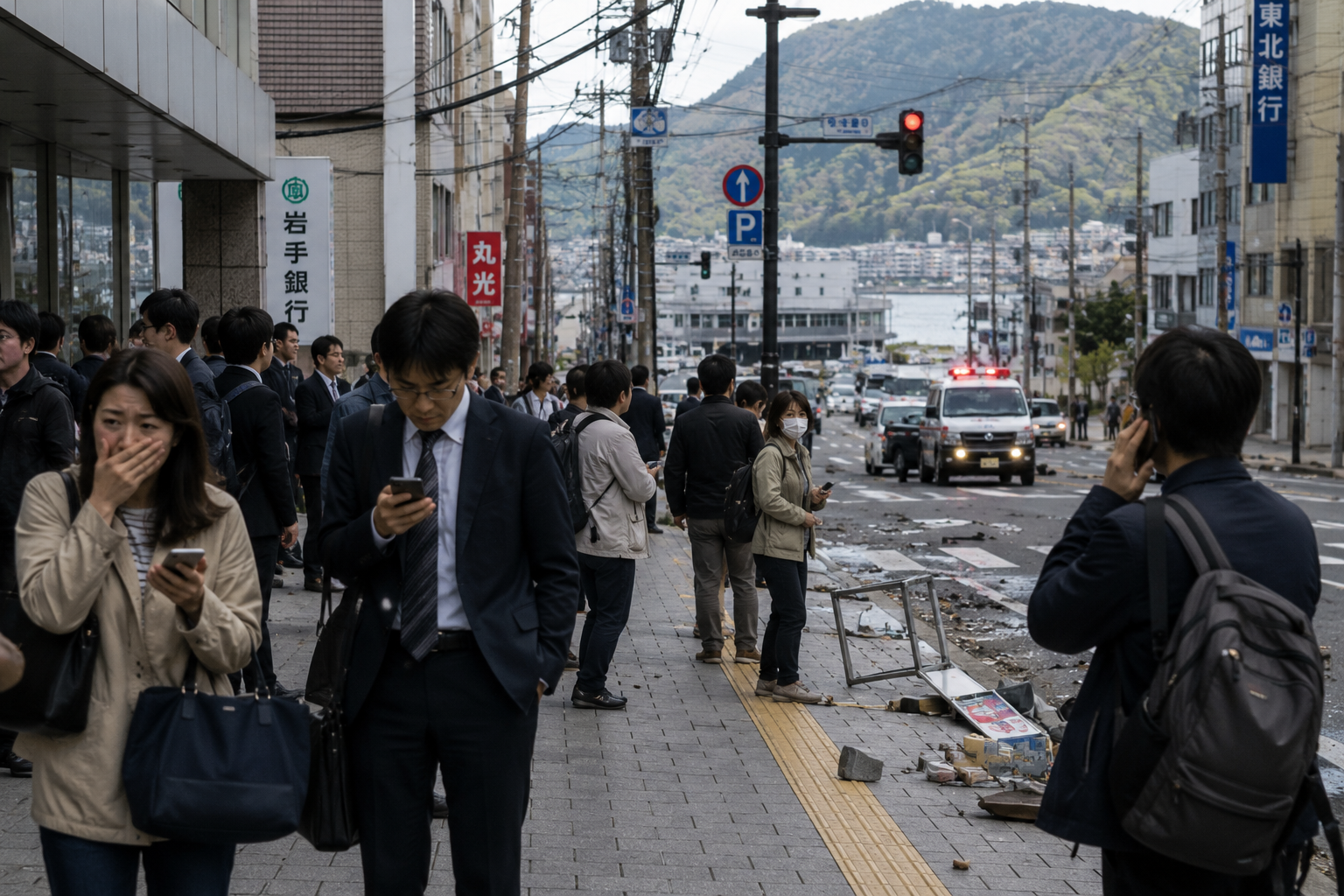
A powerful Japan earthquake struck off the coast of northeastern Japan, rattling homes, interrupting transport, and sending a fresh wave of concern through a country that knows all too well how dangerous seismic activity can be. The strong tremor hit near Iwate Prefecture during the morning rush, shaking parts of the Tohoku region and even being felt in Tokyo.
Japan experiences earthquakes every year, but not every tremor becomes a major national story. This one did. The Japan earthquake was strong enough to trigger emergency checks, briefly disrupt train services, and remind people of the country’s painful history with major quakes and tsunamis. Early reports suggested there was no tsunami warning and no immediate sign of major destruction, but the strength of the quake still made it a serious event.
The quake was reported at magnitude 6.9 by the Japan Meteorological Agency and also measured at 6.9 by the U.S. Geological Survey in early reporting, though some later coverage referred to it as 7.2 after revisions. The epicenter was off the eastern coast of Iwate, at a depth of around 50 kilometers. That combination of size, location, and timing is why this Japan earthquake quickly became breaking news across Asia and beyond.
Here are the 7 most important facts about the quake, what happened afterward, and why this event matters.
1. The Japan Earthquake Struck Off Iwate During the Morning Rush
The Japan earthquake hit on Thursday morning local time, striking off the coast of Iwate Prefecture in northeastern Japan. According to the Japan Meteorological Agency, the quake occurred at around 7:30 a.m. and had a depth of roughly 50 kilometers. Reports placed the epicenter in the Pacific Ocean off Japan’s northeast coast, with one report saying it was about 42 kilometers from Kuji in Iwate.
The timing mattered. A strong quake during the morning rush creates immediate anxiety because people are already on the move. Trains are running, offices are opening, children are heading to school, and roads are busy. In a country like Japan, where earthquakes are common but still dangerous, that kind of timing turns a strong tremor into a major public safety event.
This Japan earthquake was also widely felt because it struck in a part of the country that has seen repeated seismic activity in recent months. That added to public concern almost immediately.
Why the location drew attention
Iwate is not just another coastal prefecture. It sits in a region deeply shaped by earthquake history, especially after the 2011 Great East Japan Earthquake and tsunami. So when a major Japan earthquake hits off the coast of Iwate, the reaction is always more intense because people know what a large offshore quake can mean.
2. The Quake Was Powerful Enough to Shake a Wide Region
A 6.9 magnitude quake is not minor by any standard. It is powerful enough to rattle buildings, throw items off shelves, and cause real concern even if major destruction does not follow. In this case, the Japan earthquake was felt not only in the northeast but also farther south, including parts of Tokyo. Early reporting said the shaking in Tokyo was relatively mild, but it was still enough to remind people just how far strong seismic waves can travel.
On Japan’s seismic intensity scale, one report said the hardest-hit area reached upper 6 in Aomori Prefecture. That level of shaking is extremely strong. It is defined as intense enough to make it difficult to remain standing and, in some cases, hard to move without crawling.
That helps explain why this Japan earthquake immediately became a major national story. Even when large structural damage is not yet visible, a quake strong enough to register at that level demands attention from emergency officials, transport operators, schools, and residents.
What made the shaking feel so serious
Several things made this Japan earthquake feel especially alarming:
- It happened during the morning rush hour
- It struck in a region with a long memory of major disasters
- It was strong enough to be felt across a broad area
- It came after months of repeated seismic activity in northern Japan
- It hit offshore, which always raises immediate tsunami concerns
That mix of strength, timing, and geography is exactly why the story spread so quickly.
3. No Tsunami Warning Was Issued, and That Was a Major Relief
One of the first questions after any offshore Japan earthquake is whether a tsunami warning has been issued. In this case, the answer was one of the most reassuring early developments: no tsunami warning was issued by Japan’s weather agency. Officials said no tsunami damage was expected, aside from the possibility of slight sea level changes.
That detail cannot be overstated. In Japan, an offshore earthquake immediately revives memories of the 2011 disaster, when a massive undersea quake triggered a devastating tsunami that killed or left missing around 18,500 people and led to the Fukushima nuclear disaster. Because of that history, every strong offshore Japan earthquake triggers a moment of national suspense until tsunami risks are clarified.
This time, the lack of a tsunami warning helped calm the situation. It did not erase the danger of the earthquake itself, but it sharply reduced fears of a second, even more destructive phase of the disaster.
Why “no tsunami warning” matters so much in Japan
For many countries, an earthquake is one event. In Japan, an offshore quake can be the start of something much worse. That is why tsunami warnings are such a critical part of the response. In this case, the fact that the Japan earthquake did not trigger a tsunami warning was one of the biggest reasons the event stayed in the category of a major scare rather than a full-scale national emergency.
4. Train Services and Daily Life Were Disrupted, Even Without Major Damage
Even when a strong Japan earthquake does not cause widespread destruction, it can still disrupt daily life in important ways. Early reporting said some train services were suspended or partially halted while safety checks were carried out. Schools in affected areas also took precautions, and one report said a local school in Aomori temporarily closed and sent students home.
That response is typical in Japan, where transport operators and local authorities tend to move quickly after strong shaking. It is not just about visible damage. Officials also have to inspect rail lines, stations, roads, bridges, and buildings to make sure hidden structural problems do not turn into bigger accidents later.
The Japan earthquake also caused a more personal kind of disruption. Reports described items falling from cupboards, security cameras shaking violently, and people pausing their morning routines to check their homes and families.
Small disruptions can still tell a big story
Not every major earthquake leaves collapsed buildings behind. Sometimes the most revealing signs are smaller:
- Trains are paused for emergency inspections
- Schools send children home as a precaution
- Residents report falling objects and damaged household items
- Offices and shops stop operations while buildings are checked
- Emergency teams gather information even before full damage reports come in
That is why the Japan earthquake still mattered, even without early reports of catastrophic destruction.
5. Officials Reported No Immediate Major Damage or Nuclear Problems
One of the most important parts of the early response was the update from government officials that there were no immediate reports of injuries or major damage. Top government spokesperson Minoru Kihara also said there were no abnormalities reported at nuclear facilities, including Fukushima Daiichi and a spent fuel reprocessing plant in Aomori.
That update was critical. Any major Japan earthquake near the northeast coast raises questions not just about homes and roads, but also about nuclear infrastructure because of the region’s history. The Fukushima plant remains a symbol of how an earthquake and tsunami can trigger a much wider crisis, so even a quick statement that facilities are operating normally carries enormous public importance.
Still, “no immediate damage” does not mean the event is over. Earthquake assessments often take hours, and sometimes longer, especially in rural or coastal areas where inspection teams need time to reach every location.
Why damage checks continue long after the shaking stops
After a strong Japan earthquake, officials typically inspect:
- Rail lines and stations for hidden structural stress
- Roads and bridges for cracks or movement
- Public buildings and schools for interior hazards
- Nuclear and industrial facilities for abnormalities
- Coastal areas for landslides, sea level changes, or infrastructure damage
So while the early news was reassuring, the real story always unfolds over the following hours.
6. The Quake Hit a Region Already on Edge from Repeated Seismic Activity
This was not the first strong tremor to hit northern Japan in recent months. Reports noted that the Japan earthquake struck in an area where strong earthquakes have repeatedly been reported. One earlier quake in the region had even triggered a weeklong mega-quake caution advisory in December, and another powerful tremor struck off Iwate in April.
That pattern matters because it changes how people react. A single quake is frightening enough, but a sequence of strong tremors over months can make residents feel like the ground is never fully settled. It also keeps emergency agencies on alert and raises public anxiety about aftershocks or larger future events.
Japan is one of the most earthquake-prone countries in the world because it sits on the Pacific Ring of Fire, where several tectonic plates meet. The country experiences hundreds of earthquakes every year, though most are small. Still, the concentration of stronger recent events in the northeast has made every new Japan earthquake in the region feel more significant.
Why the recent pattern matters
Repeated strong earthquakes can create several problems:
- People become more worried about aftershocks
- Buildings and infrastructure may already be under stress
- Emergency resources remain stretched across multiple incidents
- Public confidence can weaken, especially in hard-hit coastal towns
That context is a big part of why this Japan earthquake drew such close attention.
7. The Quake Was a Fresh Reminder of Japan’s Constant Earthquake Risk
At its core, this story is about more than one tremor. The Japan earthquake is another reminder that life in Japan always includes a level of seismic risk that many other countries never face. The country is home to around 125 million people and sits on top of four major tectonic plates along the western edge of the Pacific Ring of Fire. It accounts for a significant share of the world’s earthquakes, and many of them strike without warning.
That constant risk has shaped Japan’s architecture, transport systems, disaster planning, and public awareness. It is why people receive earthquake alerts on their phones, why schools practice drills, and why train services can stop within moments of a strong shake. It is also why a major Japan earthquake is never treated casually, even when there is no tsunami and no immediate large-scale destruction.
The real lesson is not just that the quake happened. It is that Japan has built an entire national culture of readiness because it knows another quake can always come.
What People in Japan Are Usually Told to Do After a Strong Quake
After a major Japan earthquake, the advice is straightforward but important. Authorities generally urge people to stay calm, check for injuries, watch for aftershocks, and avoid unsafe buildings until inspections are complete.
Basic earthquake safety steps after the shaking stops
- Check yourself and family members for injuries
- Watch for aftershocks
- Stay away from cracked walls, broken glass, and unstable furniture
- Follow official alerts and local transport updates
- Avoid spreading rumors until information is confirmed
These steps are simple, but in the minutes after a quake, they matter a lot.
Final Thoughts
The latest Japan earthquake off the coast of northeastern Japan was a powerful reminder of how quickly an ordinary morning can turn into a national emergency scare. The quake, reported at magnitude 6.9 in early coverage, struck off Iwate during the rush hour, shook a wide region, interrupted transport, and revived memories of past disasters. The good news was clear: no tsunami warning, no immediate major damage, and no abnormalities at nuclear facilities were reported in the first wave of official updates.
Still, the story matters because it highlights something bigger than one day’s headlines. Japan remains one of the most earthquake-exposed countries in the world, and every strong quake tests its infrastructure, emergency systems, and public nerves all over again. This Japan earthquake may not have turned into a catastrophe, but it was still a serious event, and another reminder that in Japan, readiness is never optional.
Read Other Interesting news here: GOP Senators Iran Vote
