

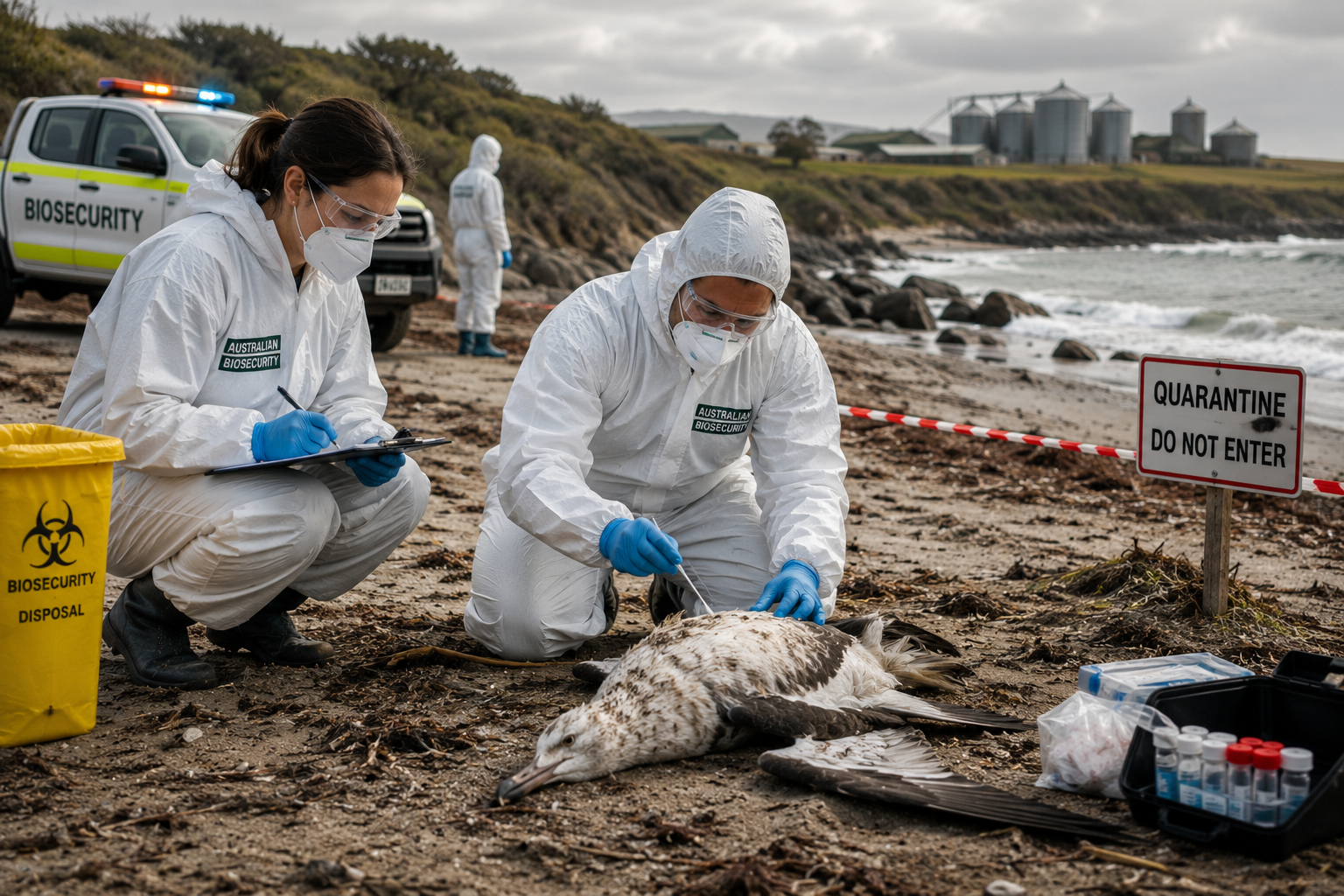
The Australia bird flu story took a worrying turn this week after officials confirmed that the highly contagious H5 bird flu strain has now been detected in a second Australian state. What was once seen as a problem limited to a remote bird case in Western Australia has now widened to South Australia, where another infected migratory seabird was found hundreds of kilometers away.
For a country that had long been spared from this strain on the mainland, the news carries weight far beyond one sick bird. Australia was, for years, the only continental landmass still free from the H5 strain, even as it caused severe disease and high death rates in poultry and wild birds around the world. That status is now under pressure, and officials are scrambling to keep the virus out of poultry farms and the wider food production system.
The good news, at least for now, is that authorities say there is no evidence of infection in poultry, no sign of mass bird deaths, and no indication that Australia’s agricultural production system has been infected. The risk to human health also remains low, according to Agriculture Minister Julie Collins. Still, the spread of H5 to a second state is a serious development, especially in a country where poultry farming, food exports, and wildlife protection are all closely tied to biosecurity.
This is why the Australia bird flu outbreak matters so much. It is not just a wildlife story anymore. It is a public health watch, an agriculture warning, and a trade risk all at once.
Australia Bird Flu Reaches a Second State
The biggest update in the Australia bird flu story is simple but significant: H5 has now been found in two Australian states. The first confirmed mainland case was reported last week in Western Australia. Now, another case has been detected in South Australia, in a migratory seabird found far from the original site.
That matters because it suggests the virus may not be confined to one isolated pocket of wildlife. It raises the possibility that infected migratory birds have carried the virus to multiple points along the Australian coastline. Agriculture Minister Julie Collins acknowledged that this is concerning, but she also said it was not unexpected given how widely the H5 strain has spread across the world.
For years, Australia managed to avoid this particular strain on its mainland even while other countries battled repeated outbreaks. That long period of protection created a sense that Australia’s geography and biosecurity systems were buying it time. But the latest Australia bird flu developments suggest that time may be running out.
Where the cases have been found so far
Here is what has been confirmed so far in the Australia bird flu outbreak:
- Western Australia confirmed the first H5 case last week
- A second H5 detection has now been reported in South Australia
- The latest infected animal was a migratory seabird
- The South Australia case was found hundreds of kilometers away from the first case
- Officials believe migratory birds may have carried the virus to more than one coastal location
That geographic spread is what makes the Australia bird flu story more serious now than it was a few days ago.
Why This H5 Strain Is Such a Big Concern
Not all bird flu stories create the same level of alarm, but the H5 strain does for a reason. The Australia bird flu concern is centered on a virus that has caused severe disease and high death rates in poultry and wild birds worldwide. It has been one of the most closely watched avian influenza strains because of the damage it can do to farms, wildlife colonies, and trade systems when it becomes established.
Julie Collins said there is no evidence of mass mortalities in Australia right now, and that matters because mass deaths among wild birds can be one of the first signs that the virus is spreading aggressively in the environment. So far, officials are describing the current situation as limited, not entrenched. Earlier this week, Collins said authorities were checking whether the virus had become established in Australian wildlife or whether the confirmed detections were still isolated events.
That distinction is critical. A few infected birds are serious. A virus entrenched in wildlife is a much bigger problem because it becomes far harder to control and much easier for the disease to keep resurfacing near farms and poultry facilities.
Why H5 worries farmers and wildlife experts
The H5 strain is taken seriously because it can:
- Spread rapidly among wild birds
- Cause heavy losses in poultry flocks
- Trigger farm lockdowns and culling measures
- Disrupt egg and chicken meat supply chains
- Lead to trade restrictions from other countries
That is why the Australia bird flu story is being watched so closely by farmers, exporters, and wildlife experts at the same time.
Australia Is Trying to Keep the Virus Out of Poultry Farms
One of the most reassuring parts of the Australia bird flu update is that officials say there is no evidence of infection in poultry and no sign that the country’s broader agricultural production system has been hit. Julie Collins repeated that point while stressing that the human health risk also remains low.
Still, the industry is clearly not taking chances. One of Australia’s largest poultry producers has already locked down farms in Western Australia in an effort to stay disease-free. That move tells you how seriously the industry is treating the threat. Even without confirmed poultry infections, the arrival of H5 on the mainland changes the risk calculation overnight.
Poultry farms are especially vulnerable because once avian flu enters a commercial flock, the consequences can be fast and expensive. It can lead to mass culling, export problems, movement controls, and long recovery periods. That is why the current Australia bird flu response is focused heavily on surveillance, testing, and prevention rather than waiting for a farm outbreak to happen first.
Why poultry producers are reacting quickly
Commercial poultry businesses have strong reasons to move early:
- H5 is hard to contain once it reaches farms
- Outbreaks can lead to large bird losses
- Export markets can react immediately
- Even a limited outbreak can damage consumer confidence
- Recovery from a farm infection can take months
In other words, the Australia bird flu threat is not only about what has happened so far. It is about what the industry is trying to stop from happening next.
The Spread Could Trigger Trade and Supply Chain Disruption
The economic risk around Australia bird flu is already becoming visible. Papua New Guinea briefly suspended imports of Australian eggs and chicken meat after the first detections, although that suspension has since been lifted with some exceptions. Even that short-lived action was a warning sign. It showed how quickly trade partners can respond when avian flu appears inside a major food-exporting country.
Trade disruption is one of the most immediate side effects of bird flu outbreaks anywhere in the world. Countries importing eggs, poultry, or poultry products often move quickly to protect their own flocks and food systems. That can create sudden pressure on exporters, producers, and domestic supply chains.
For Australia, this matters because poultry is not just a food staple at home. It is part of a wider agricultural economy that depends on trust, biosecurity, and market access. If the Australia bird flu situation grows, the economic fallout could stretch well beyond the farms closest to the outbreak zones.
What kind of disruption is possible?
If the Australia bird flu outbreak expands, the country could face:
- More import suspensions from trading partners
- Tighter biosecurity controls at farms and ports
- Pressure on egg and poultry prices
- Higher costs for producers trying to stay disease-free
- Supply chain disruption if farm movement controls become necessary
None of that has fully happened yet, but the risk is real enough that the industry is already preparing for it.
Migratory Birds May Be the Key to How the Virus Arrived
A major part of the Australia bird flu story is the role of migratory birds. The first H5 detections were linked to wild seabirds, and the latest South Australia case was also found in a migratory seabird. That pattern matters because migratory birds can travel huge distances and connect outbreaks across continents.
Julie Collins said it was not unexpected that migratory birds could arrive at different points along Australia’s coastline carrying the virus. That is one reason authorities are not treating the second detection as a random one-off. It fits a global pattern in which wild birds move the virus across regions, sometimes before local authorities even realize it has arrived.
This also explains why officials are increasing surveillance rather than focusing only on one beach or one state. If migratory wildlife is the vehicle bringing H5 into Australia, then the challenge becomes much larger than a single infected bird. It becomes a question of where else the virus may have landed, and whether it has already moved through wild bird populations undetected.
Why migratory birds matter in avian flu outbreaks
Migratory birds can:
- Carry the virus over long international routes
- Introduce infection to remote coastal areas
- Spread H5 to multiple regions before detection
- Bring the virus close to wetlands, farms, and poultry areas
- Make containment much harder than a farm-only outbreak
That is why the wildlife side of the Australia bird flu outbreak is just as important as the farming side.
Human Health Risk Remains Low, but Authorities Are Still Watching Closely
Another key part of the Australia bird flu update is the public health message. According to Julie Collins, the risk to human health remains low at this stage. There is no sign in the reporting so far of a human outbreak linked to the current detections.
That should be reassuring, but it does not mean the situation can be ignored. Bird flu outbreaks are always monitored carefully because viruses can change, spread into new animal populations, or create more risk if they move from wildlife into commercial poultry systems where human contact may be more frequent.
Officials are trying to strike a careful balance: calm the public, but stay alert. That approach makes sense. The current Australia bird flu situation is not being described as a human health emergency, but it is still being treated as a serious biosecurity event.
What officials are saying right now
Based on the latest official comments, the position is:
- Low risk to human health
- No evidence of infection in poultry
- No evidence of mass bird deaths
- Ongoing testing and surveillance continue
- Authorities are still assessing whether the virus is entrenched in wildlife
That means the Australia bird flu story is still evolving, and the next few days of surveillance could be critical.
Australia’s H5-Free Status Is Now Under Pressure
For years, Australia stood out because it was the only continental landmass free of the H5 strain. That made it unusual in a world where bird flu had already caused major damage across Europe, the Americas, Asia, and parts of the Southern Hemisphere. Now, with H5 confirmed in two states, that long-standing status is under pressure.
This is why the current outbreak feels bigger than the number of cases might suggest. On paper, the confirmed detections are still limited. But symbolically and strategically, the arrival of H5 on mainland Australia is a major shift. It means Australia is no longer standing outside the global spread of this strain. It is now part of that story.
The next phase will depend on whether officials can keep the virus from becoming established in wildlife or spilling into poultry farms. If they can, Australia may still contain the damage. If not, the Australia bird flu story could grow much larger in the weeks ahead.
Final Thoughts
The Australia bird flu outbreak has entered a more serious phase after H5 was detected in a second state, moving the issue beyond a single isolated case in Western Australia. With another infected migratory seabird now found in South Australia, officials are facing a tougher question: is this still a limited wildlife event, or the beginning of a wider mainland spread?
For now, there are still important reasons for caution rather than panic. Authorities say there is no evidence of infection in poultry, no sign of mass mortalities, and low risk to human health. But the situation still matters because H5 has a long history of causing severe losses in birds, damaging poultry industries, and disrupting trade. Australia’s poultry producers are already locking down farms, and trade concerns have already surfaced.
In short, this is one of those moments where the next steps matter more than the first headline. If surveillance shows the virus is not entrenched, Australia may still contain the problem early. But if more infected birds turn up across the coastline, the Australia bird flu story could quickly become one of the biggest agriculture and wildlife challenges the country has faced in years.
Read Other Interesting news here: Japan Earthquake
